I was not the most rambunctious of children, neither was I a saint. I dealt my fair share of deviousness to those around me, oftentimes to my unfortunate parents, and believe me; I received plenty in return. There’s a mentality that I think my parents possessed that goes something like: let kids be kids. I thank them for standing true to this mantra and for enduring what may have driven them nigh to insanity; it kept me sane. Running, exploring, rollerblading behind bikes, cars and dogs, and dismantling things with insatiable curiosity kept me from stagnation and helped me to see a brighter, more vivid world than my couch-dwelling classmates. It led me to make choices later in life-like high school athletics, motorcycles, skiing, snowboarding, hiking and an all-around active lifestyle. These are all part of my personal identity, which I have to say, I think it’s pretty good.
I look around today and think: my mother is a rare woman. It seems that she is of a dying breed who cooks meals for their family, and rarer still she who does everything else the family needs. Truly, these women are the reason behind every great accomplishment this world has seen. Maybe that’s all a little old-fashioned, but I like to think our family was a little old-fashioned.
Saturdays were family work days. In the summertime we usually worked out in the yard, weeding, digging, planting, grooming and generally beautifying our little plot of earth. During the winter months we found ourselves helping with various chores like cleaning out old closets and sanitizing a shared bathroom that only three young boys could consistently make filthy. Regardless of the time of year, as soon as our chores were finished our chores and up to my mother’s standards we were out the door.
I remember one particular warm summer afternoon. I hastily made my escape after finishing my daily chores and met up with Ryan Lee and Reagan Wing. After some discussion on what we were going to do that day, whether it be to finish fixing our go-cart or build a downhill racer we settled on going into “the Gully,” as it was known. The Gully was a place where the canyon extended down into the valley, crossing right through Sandy city and ending somewhere by Jordan High school. I say “somewhere” as if to sound like I vaguely know, but that would be a lie. We knew that place from top to bottom like the back of our hands; from the flats where you could always find a magpie at which to shoot your slingshot, to what was known as ‘the tunnel’ – a place you wouldn’t be caught dead after sundown. It seems that it used to be that many people were acquainted with a ‘Gully’ of their own, either through personal experience or from readings about a young boy’s adventures in any good book. Nowadays the only gully in some people’s lives is the spot between the couch cushions.
We made our way into the Gully, which was conveniently located at the border of our neighborhood, kicking the tall grass when we entered to see if we could scare out an unfortunate grasshopper that we would chase down endlessly or throw stones at ‘til it was good and dead. We made our usual route, down past the old cement coffin vault yard and across the railroad tracks that bisect Sandy (a good place to find and throw rocks), but instead of going through the gap in the chain link fence to our usual stomping grounds we decided to make a right and hop the dirt berm, down closer to the canal. It was there that we saw what adult eyes would describe as an overgrown, weedy, thorny, unsightly russian olive tree, but we knew better. We knew a fort-tree when we saw one. Its camouflage was perfect. Low-hanging branches concealed it from secret entry to lookout roost, and, with a little hatchet work on the inside, there was ample space to accommodate a plotting station and several floors for hatching secret plans to take over the world.
From roots to tree-top we built our fortress of solitude, trimming branches, nailing on planks for a ladder to the upper levels and carrying up boards to build a floor. It was there that I experienced the exquisite pain of a long, slender russian olive thorn gliding into the nail bed of my right thumb as I was sawing away at a branch. That nail grows funny to this day and is a constant reminder of summer fun.
Where did we get our fort-building materials? Everywhere; Reagan had a pile of old scrap wood in his backyard and if that didn’t have what we needed the rest was just a fence hop away, if you know what I mean. The Toones, a family just down the street, were good for nails and if we asked nicely we’d get a handful; Ryan always could muster up twine and rope for the rest of it, and my garage was our tool kit. Sometimes we’d make multiple supply runs a day, back and forth, hauling stuff with wagons, bikes, and occasionally a 3-wheeler; with permission of course. After weeks of hard work, it was done, and to our young eyes it was beautiful. Concealed from the nearby trail, the only hint that its existence was the thin, winding path which we were careful to conceal with dry sagebrush and weeds as we left. (image)
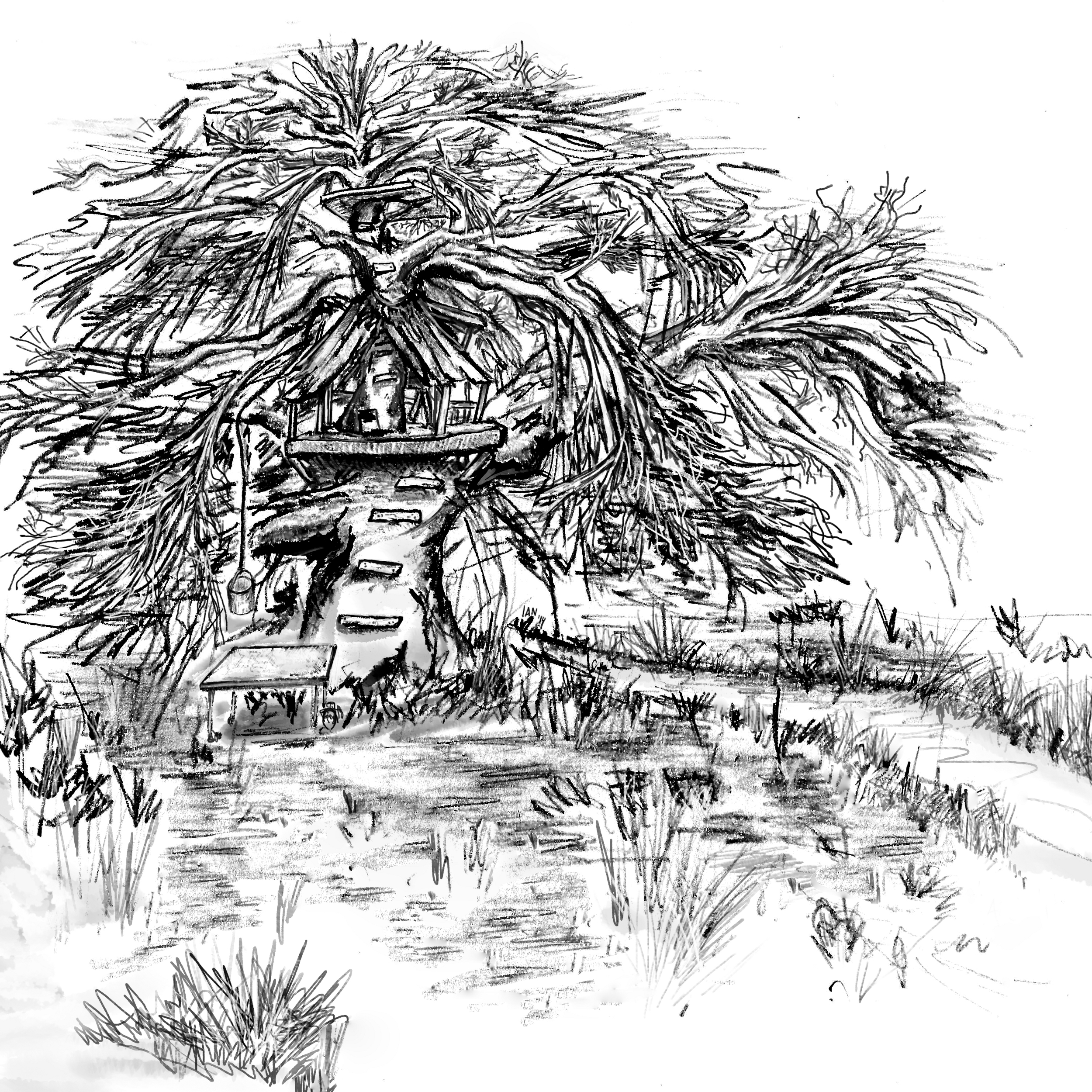
Here’s a semi-embellished sketch of the finished product. It probably wasn’t quite this nice in real life but it sure seemed like it!
We enjoyed our fort building time and didn’t waste time enjoying our fine handiwork. After a few days of joking, fishing from the limb over the canal, and some knot tying we moved on. I think we wordlessly agreed that the fort was more of a monument to our neighborhood fame than a place to linger for too long. We left it as a place for other kids to stumble upon and be inspired to play and have fun. We ourselves were a restless bunch and when that was all done we packed our tools, hid the trail good and well and took off to the Gully’s lower parts to catch toads.
When we were a little older, the three of us returned to see what had become of our little fortress. With no one to give it the care it needed the tree had grown in places and most of the boards could do with a few more nails. It appeared that someone, or more likely “some ones,” had happened upon it and used it as a place to do things that kids ought not to do. There were beer cans strewn about and scandalous magazines which we quickly dispatched into the canal for the fish to read. We silently said our goodbyes and walked away, regaling each other with stories of Gully days.
That tree was my summer classroom. I learned to work with a team, make compromise, and that hot summer days were better spent hammering away at an unruly nail than dwelling on a couch in front of a television. The experiences we had running through the Gully bonded the three of us together in a unique way that playing Madden could never have. We learned to be active.
In our freshman year of high school Ryan, Mike (an addition to our gang) and I joined the swim team. I know swimming doesn’t have the same spurious reputation as the “real” high school athletes (*cough* ..football..) but we weren’t really worried about that anyhow. We were just doing it for the fun of swimming. We did however get more serious as we participated in heated competition against arch rivals from neighboring schools. We got into the rigorous regimen of an hour of early morning swim practice before school and two hours after. We worked hard and all improved our times. We went to the gym, ran, and ate a great deal of food to have the necessary 3,000 to 6,000 calories to swim one to two miles per day (American Diabetic Association), and eventually all made it to compete at state.
Juxtaposed with this lifestyle we formed, I also had other friends growing up who gave me valuable insights into contrasting upbringings. Nate’s parents seemed a little stricter than most and you might say their family wasn’t exceptionally active. When we played with Nate, we usually sat around playing board games or watching someone play on their Playstation. This is troubling given that couch-dwelling children who watch four hours or more of television per day are likely to have greater body mass index (BMI) than those who watch less than 2 hours per day and that these habits extend into adulthood (Anderson). Additionally, these adolescent habits are key indicators of adult adverse health and illnesses like obesity, high blood pressure, heart disease, diabetes and secondary aging (Boreham; Mcmurray).
Each day I see children everywhere fixated on these magical interactive screens. Our sunday worship services used to be a place where kids couldn’t hold still through an hour meeting, and nobody blamed them. Now, with all children tuned into their devices I don’t have any cover noise in case I accidentally doze off and let out a snore or two. While I worry about the side effect this has on their attention spans, my concern for their waistline is somewhat greater, and those kids are far too good at those games for me to think they only practice at church.
In David Zinczenko’s article, “Don’t Blame the Eater” which was published in the New York Times in 2002 he talks about portly children and how their mass may not be their fault. I tend to sympathize with that notion, but not in the way that people in his camp might think. Zinczenko believes that fast food companies are to blame for the fat plague. While it is true fast food companies have a menu with enough caloric content to fuel an international flight, it’s not about what they offer – it’s about the choices we make here and now. I would look past Nate for his couch conundrum to his parents sitting in front of one of several TVs at their home. And quite possibly this is all more cyclical than we care to imagine; that his parents learned it from his grandparents’ examples, but the buck has to stop somewhere and it’s high time we take our stand here and now. Let kids be kids and love them enough to hurt their feelings by restricting their couch-iPad time; make them dig in the dirt for a while.
Works Cited
Andersen, R. E. “Relationship of Physical Activity and Television Watching With Body Weight and Level of Fatness Among Children: Results From the Third National Health and Nutrition Examination Survey.” JAMA: The Journal of the American Medical Association 279.12 (1998): 938-42. Print.
Boreham, Colin, and Chris Riddoch. “The Physical Activity, Fitness and Health of Children.” Journal of Sports Sciences 19.12 (2001): 915-29. Web.
“Fueling Swimmers.” Student Health Services. American Diabetic Association, n.d. Web. 1 Feb. 2014. <http://studenthealth.ucsd.edu/pdfdocs/swimmers.pdf>.
Mcmurray, Robert G., Joanne S. Harrell, Shrikant I. Bangdiwala, and Jianhua Hu. “Tracking of Physical Activity and Aerobic Power from Childhood through Adolescence.” Medicine & Science in Sports & Exercise 35.11 (2003): 1914-922. Web.
Zinczenko, David. “Don’t Blame the Eater.” Graff, Gerald, Cathy Birkenstein and Russel Durst. They Say/I Say: The Moves That Matter in Academic Writing: with readings. 2. New York: W. W. Norton & Company, 2006. 391-394. Print.

 ianbakker